Lock Failure
Thin metal pins bend under repeated daily use.

Compare real performance results and see why schools trust Generation Faraday over other pouches.

Choosing the wrong solution doesn’t just affect performance; it impacts consistency, accountability, and long-term adoption.
Thin metal pins bend under repeated daily use.
Liner damage permanently reduces signal blocking.
Stitched seams allow water to compromise the Faraday layer.
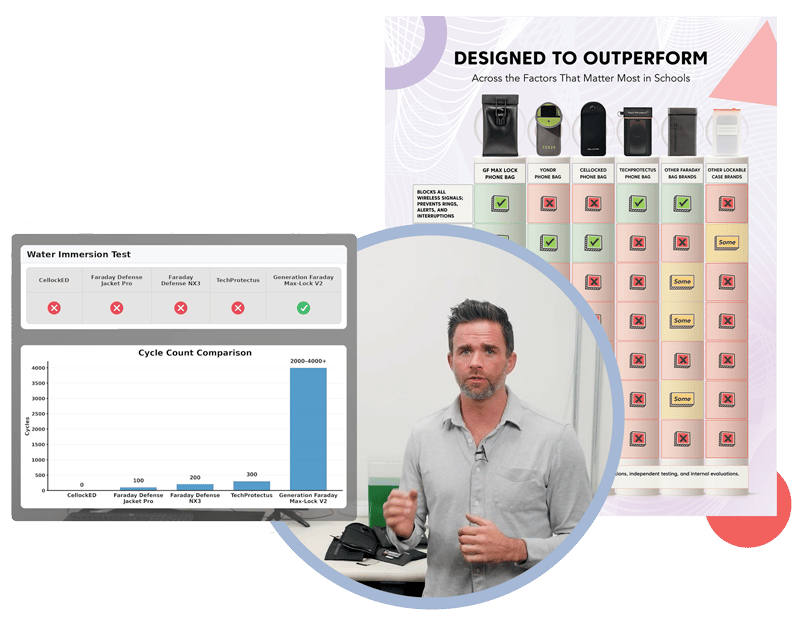
Repeated cycle testing shows 20–40× longer maintained performance under daily school conditions.
Maintains shielding integrity after thousands of openings, ensuring consistent signal blocking throughout the school year, not just when the pouch is new.
Prevents moisture from degrading internal shielding, helping schools avoid mid-year failures caused by spills, humidity, or daily wear.
No thin pin to bend or fail under daily use.
Compared to tested alternatives under repeated cycling.
A “cycle” represents one full open-and-close use of the pouch; placing a device inside, securing it, reopening it, and removing the device. In a typical school environment, bags may be opened and closed 5–10 times per day.
At that rate, a pouch tested to 200 cycles may show failure within weeks. A pouch tested to 3,000–4,000 cycles is designed to withstand years of daily classroom use.
For schools, that means fewer broken pouches, fewer classroom disruptions, and fewer replacement orders mid-year. Durability directly impacts enforcement consistency and long-term program success.
In testing, Generation Faraday maintained signal integrity 20–40× longer than tested alternatives.
Key: ✅ Yes ❌ No 🟡 Some models
|
|
Yondr | CellockED | TechProtectus | Other Faraday Bags | Other Lockable Cases | |
| Blocks all Wireless Signals | ✅ | ❌ | ❌ | ✅ | ✅ | ❌ |
| Secure, Tamper-Resistant Lock | ✅ | ✅ | ✅ | ❌ | ❌ | 🟡 |
| Magnetic Closure Designed for Long-Term Use | ✅ | ❌ | ❌ | ❌ | 🟡 | ❌ |
| Waterproof, Durable Exterior | ✅ | ❌ | ❌ | ❌ | 🟡 | ❌ |
| Serialization and RFID Tracking | ✅ | ❌ | ❌ | ❌ | ❌ | ❌ |
| Customization Options | ✅ | ❌ | ❌ | ❌ | 🟡 | ❌ |
| Expected Service Life of 4+ Years | ✅ | ❌ | ❌ | ❌ | ❌ | ❌ |

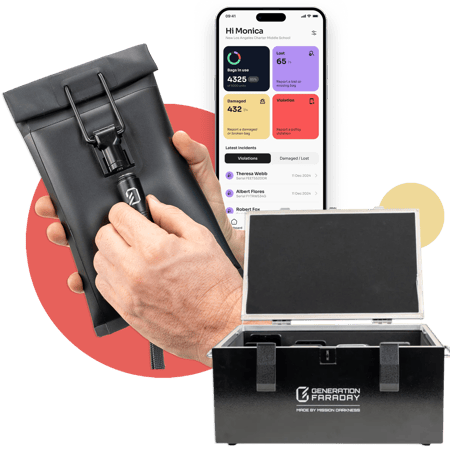
Generation Faraday combines signal-blocking hardware, serialized tracking, app-based management, and implementation support.
Examine performance, durability, and system features.
Determine enforcement goals, accountability requirements, and scale.
Get a customized recommendation based on your implementation plan.

West
Katey Secrist
+1-323-208-5600 (PT)
katey@generationfaraday.com

Midwest
Dianne Dunning-Gill
+1-314-766-7972 (CT)
dianne@generationfaraday.com

Southeast and Gulf Region
Tracy Kirsch
+1-404-889-2279 (ET)
tracy@generationfaraday.com

East
Melissa Torba
+1-805-836-3542 (ET)
melissa@generationfaraday.com

Districts across the country rely on Generation Faraday for durable, signal-blocking phone control.

Dr. Suzy Lofton-Bullis
Deputy Superintendent, Lago Vista ISD
“The implementation of Generation Faraday’s signal-blocking pouches on our secondary campuses has been surprisingly smooth...we are already seeing a positive impact on instruction and the overall learning environment. We are excited about this partnership and look forward to working with Generation Faraday to provide more focused, engaged classrooms across Lago Vista ISD.”
No. Some products are designed to reduce signal strength rather than fully block WiFi, cellular, and Bluetooth connections. True signal blocking requires a properly constructed faraday liner and secure closure that prevents signal leakage. Without those elements, notifications and connectivity may still occur. When evaluating options, it’s important to confirm whether full signal isolation is a core design feature or not.
Yondr pouches are designed to secure phones during use, but they do not use a faraday liner to block wireless signals. Devices placed inside a Yondr pouch may still maintain WiFi, cellular, or Bluetooth connectivity. Schools evaluating signal-blocking solutions should confirm whether full wireless isolation is required for their policy goals.
In school environments, phone pouches are exposed to spills, weather, and daily handling. If moisture reaches the internal faraday liner, signal-blocking performance can degrade permanently. Waterproof construction helps protect the shielding layer and extend the usable lifespan of the pouch. Over time, this can mean the difference between months of use and years of reliable performance.
The lifespan of a Faraday liner depends on construction quality and how often the pouch is opened and closed. Repeated bending, friction, or moisture exposure can damage the shielding material. In testing, some alternatives showed signal degradation within a few hundred cycles. Solutions engineered for thousands of cycles are better suited for daily classroom use over multiple school years.
RFID is not required for basic phone containment, but it can significantly improve accountability and inventory management at scale. Serialized tracking allows districts to monitor deployment, reduce loss, and maintain compliance across classrooms or campuses. For larger implementations, these tools can simplify oversight and reporting.
An app enables district-level visibility beyond the individual pouch. With serialized tracking and dashboard reporting, administrators can monitor distribution, inventory, and compliance in real time. For schools managing large deployments, this adds operational control that manual systems cannot provide.